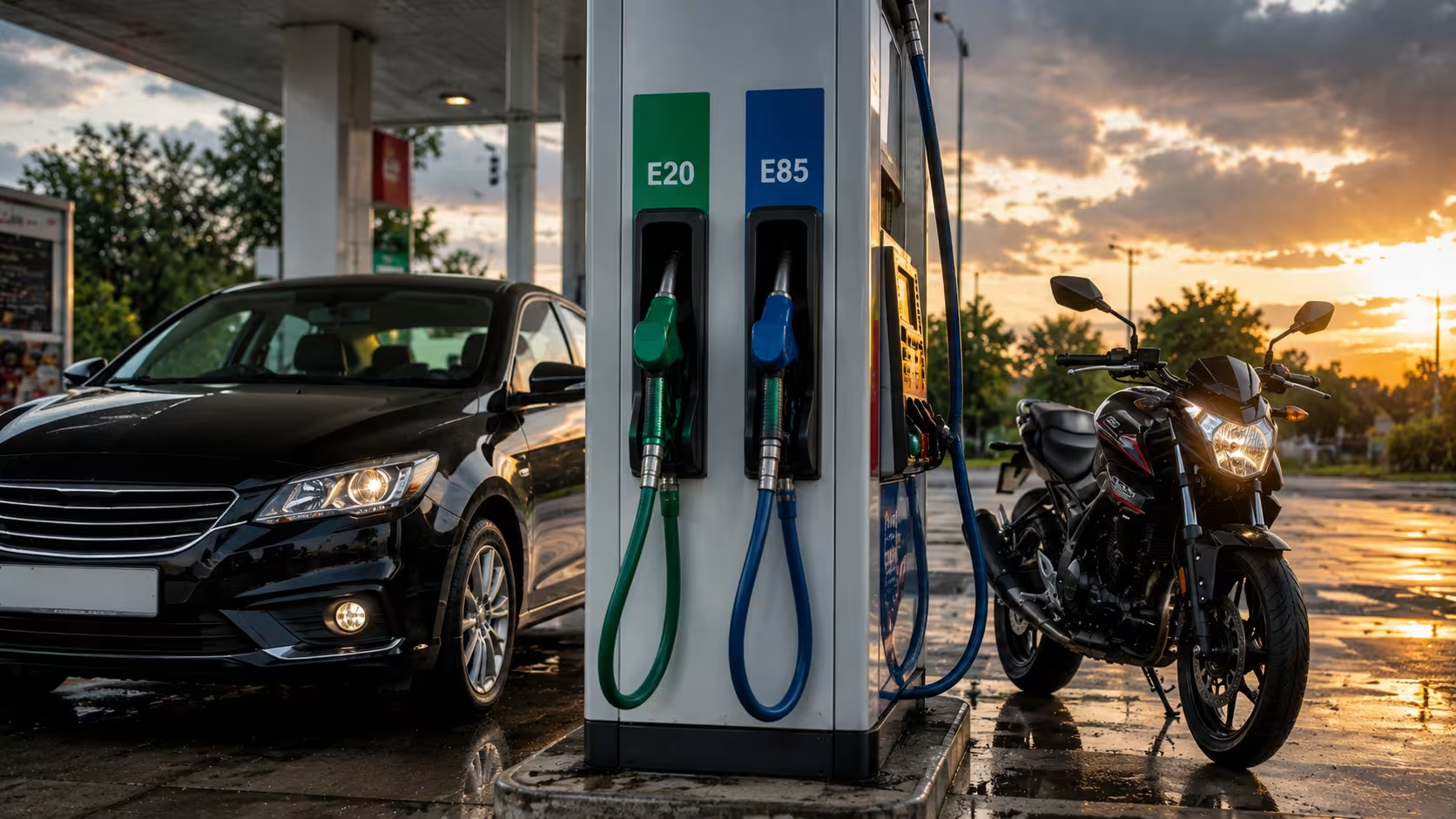
What you put into your car impacts far more than today’s gasoline expense. It impacts engine refinement, throttle response, long term dependability, maintenance costs and even resale value. And this is the reason why the expanding conversation over E20 vs E85 Fuel has grown more and more significant for owners of cars and motorcycles.
India has already started using E20 petrol as part of its ethanol blending strategy while E85 gasoline has been making news abroad because of its usage in flex-fuel cars. On paper, they both offer lower emissions and less dependency on fossil fuels. But do they really enhance the driving experience, or are there trade-offs that all owners should be aware of?
Over the last several months, I’ve talked to technicians, owners of ethanol-compatible vehicles, and looked at manufacturer recommendations to understand where these fuels really shine – and where expectations frequently outstrip reality. It immediately became obvious that a lot of drivers still mix up E20 and E85, thinking that they are just stronger versions of conventional gasoline. But they are built for quite different kinds of automobiles and ownership demands.
READ MORE: Sedan vs SUV: Which One Should You Buy in 2026? Complete Comparison Guide
Understanding E20 Fuel
E20 fuel is a mixture of 20% ethanol and 80% gasoline. Ethanol is a renewable fuel itself, manufactured mostly from sugarcane and other agricultural products. The Indian government has aggressively pushed E20 to cut crude oil imports, boost energy security and reduce car emissions.

Most new BS6 Phase 2 vehicles and bikes don’t require E20 adjustment or have very little to do because the manufacturers have already set their engines for this mix. However, older vehicles may not always be suitable, particularly if their fuel system components were never built to resist greater ethanol percentages.
For most drivers, upgrading to E20 is often painless. For the majority of individuals, there will be no big changes to their daily commuting, although they could notice a minor loss in fuel economy, as ethanol carries less energy than petrol.
What Makes E85 Different?
E85 is in a completely different league.
E85 is not only 20% ethanol, it is up to 85% ethanol and is only appropriate for use in specially developed flex-fuel vehicles (FFVs). These cars have ethanol-resistant fuel lines, updated injectors, revised ECU programming and engine calibration tailored for high ethanol concentration.
The car industry has been behind flex-fuel technology for years and that’s why countries like Brazil and the United States have successfully embraced E85. However, in India E85 is still in its nascent stage, which means that infrastructure and compatible vehicles are still restricted.
E85 has some very amazing octane ratings and may bring out the best in suitable engines, but it should never be utilized in a normal petrol car.
E20 vs E85 Fuel: Where the Real Difference Appears

You don’t just look at the proportion of ethanol and get the complete story.
The main difference is vehicle compatibility.
E20 is meant to be a transition fuel that allows millions of existing cars to convert towards greener transportation with minimum disturbance. E85 on the other hand requires a specially designed engine to handle the high ethanol percentage.
Performance’s different too.
E85 has a substantially higher octane rating, which means compatible engines may run higher compression ratios and provide greater acceleration. But the trade off is increased gasoline use since ethanol has less energy per litre.
E20 also benefits from cold weather performance, but E85 engines generally need more careful tuning for quicker cold starts.
Maintenance needs are different, too. Most modern E20 compliant automobiles require no extra servicing beyond normal maintenance. E85 systems, however, depend on ethanol-resistant seals, hoses, pumps and injectors to avoid premature wear.
Our Practical Driving Assessment

In the day-to-day city E20 drives virtually exactly like ordinary petrol. Engine refinement stays smooth, throttle response is predictable, and stop-and-go traffic is no problem in compatible cars.
The highway performance is still reassuring. Overtaking is no big deal and the natural feeling of motoring at steady speeds comes through. You may notice a little loss of kilometres per litre, but only if you are a motorist who watches fuel economy closely.
E85 has a distinct story to tell.
Inside a well constructed flex-fuel engine, acceleration feels crisper, and the engine seems more eager under hard throttle. The faster you pull, the stronger it gets, particularly in performance applications where the higher octane level allows for more aggressive ignition timing.
But these improvements don’t come for free.
Ethanol costs cheaper than petrol at times but fuel consumption is high so drivers need to make more frequent visits to fuel stations.
Having looked at numerous ethanol fuel systems I have come to the realisation that it is a mistake too many enthusiasts make to judge fuel quality on mileage or power. Engine compatibility, maintenance needs, service costs, dependability and sheer performance all play a part in long term ownership. A gasoline that gives you a kick in the pants but eventually leads to pricey repairs isn’t necessarily the superior choice.
How These Fuels Affect Your Engine
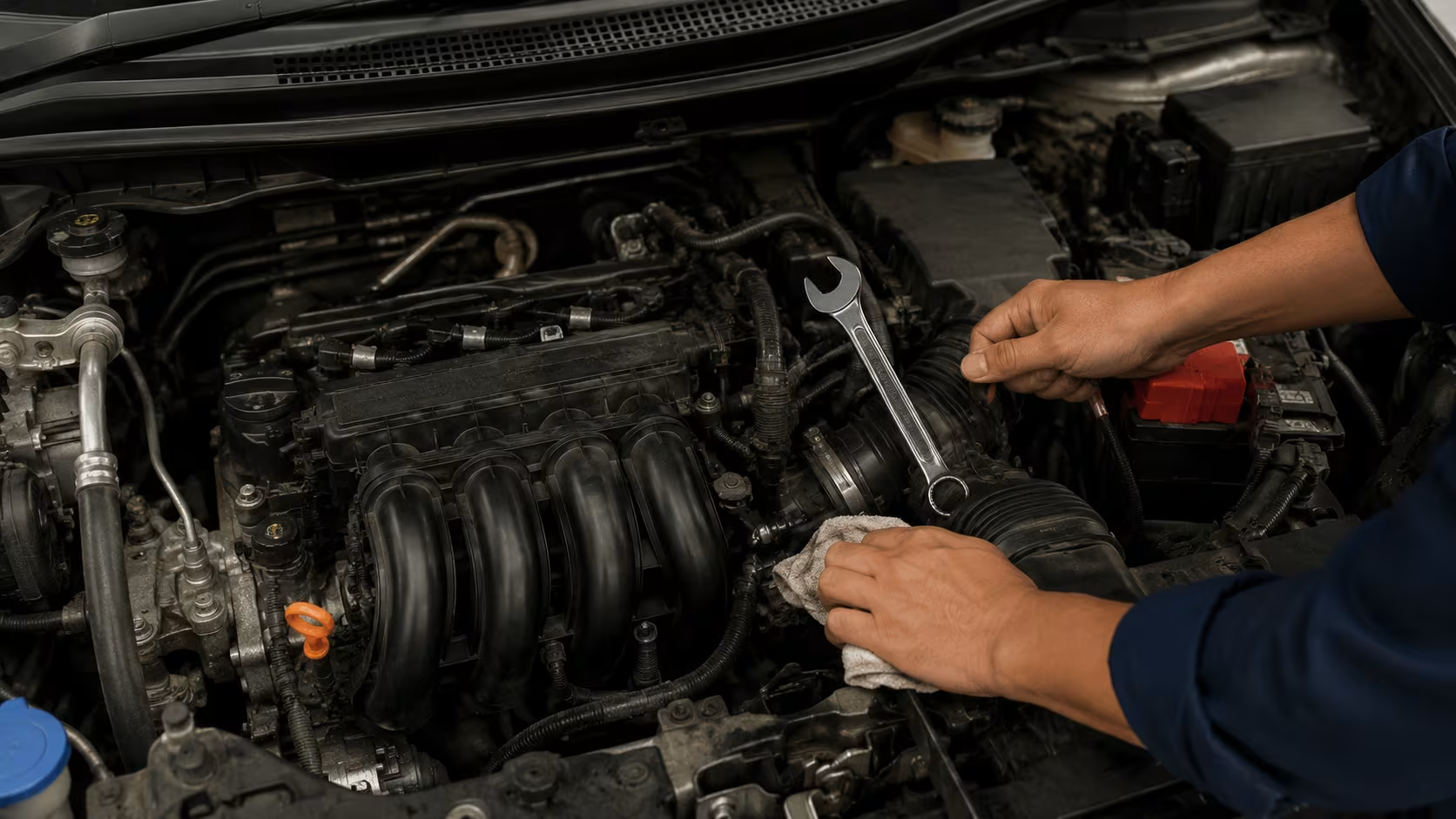
One of the primary advantages of E20 is that it works with the latest generation of petrol engines without any major adjustments.
Manufacturers have already made changes to combustion mapping, ignition timing and fuel delivery systems in response to ethanol’s distinct combustion properties. As long as the planned maintenance is followed, long term dependability should not be harmed much.
E85 puts more demands on the vehicle.
It takes on more moisture since it has more ethanol in it and it reacts differently in the fuel system. That’s why flex-fuel cars have enhanced hoses, corrosion-resistant fuel lines, specifically built injectors and sophisticated ECU programming.
E85 in a regular gasoline engine may harm seals, fuel pumps, injectors and other parts over time.
Mileage and Performance Comparison
For the average everyday commuter, E20 provides a sensible combination of emissions, cost and usefulness. Fuel economy is near regular fuel and retains familiar driving characteristics.
E85 will usually get lesser mileage, while it offers more performance potential. It takes more fuel to produce the same amount of energy.
For those wanting the most practical, for drivers, E20’s ease will probably be appreciated, while for enthusiasts who own factory-built flex-fuel cars, E85’s higher performance capacity would be appreciated.
Which Fuel Makes More Sense?
If you own a modern BS6 petrol car or motorcycle approved for E20, there is little reason to avoid it. It supports India’s renewable fuel goals, requires no significant lifestyle adjustment, and integrates smoothly into daily driving.
For readers who wish to get an idea of how ethanol blending is progressing in India and worldwide, it is recommended looking to official materials from the Ministry of Petroleum & Natural Gas (MoPNG) and the International Energy Agency (IEA). These organizations issue periodic reports on ethanol legislation, fuel adoption and renewable energy projects that impact the future of transportation.
E85 should only be considered by owners of genuine flex-fuel vehicles. Its impressive performance benefits simply cannot outweigh the risks of using it in an incompatible engine.
From my perspective, the smartest fuel choice has never been about chasing the highest octane number or the biggest marketing claim. It’s about matching the fuel to the engineering of your vehicle. Over years of covering automotive technology, I’ve found that manufacturers spend thousands of hours calibrating engines for specific fuels, and ignoring those recommendations rarely ends well. Choosing the correct fuel today is one of the easiest ways to protect your engine, reduce maintenance costs, and enjoy dependable performance for years to come.