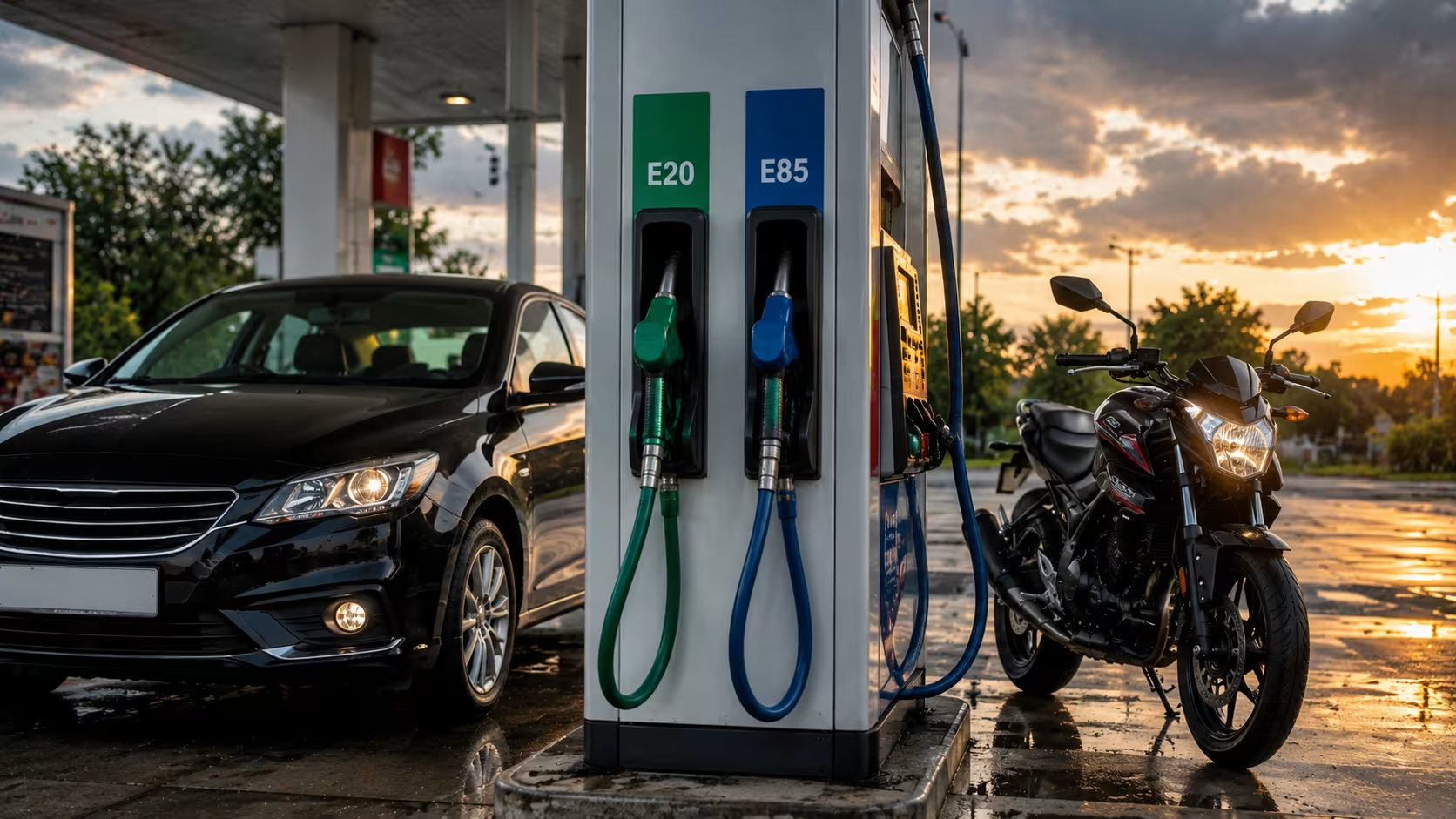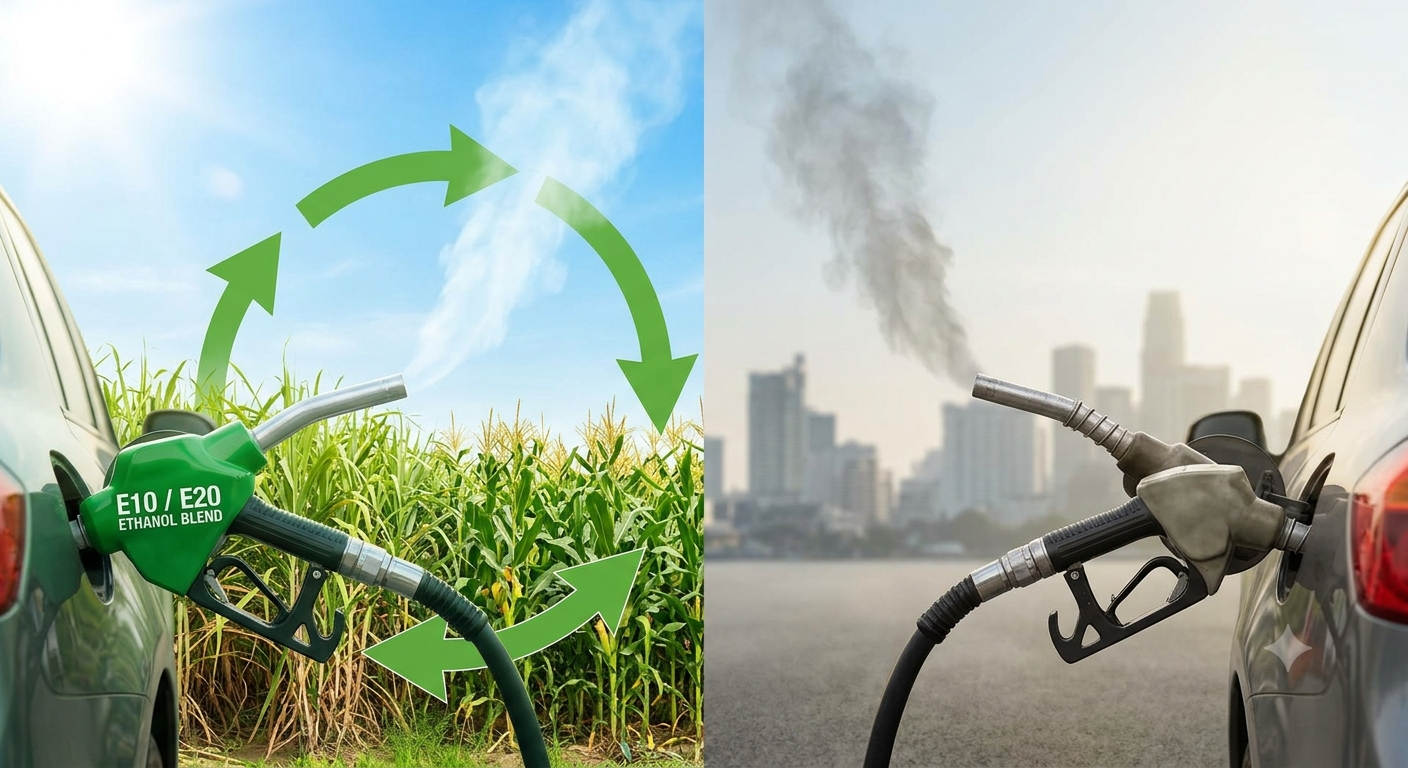
The movement towards ethanol-blended fuel in India is no longer just a facet of government policy but part of millions of car owners’ daily lives. E20 petrol (20% ethanol and 80% petrol) has become freely available across the country since April 2026 as part of India’s phased plan to reduce crude imports and vehicular emissions. Though the government and carmakers say the transition is benign, many drivers are asking practical questions: Why has my range decreased? Will it affect my engine? Am i able to fill e20 in my old vehicle The issues at stake in the Indian automobile sector today have thrown up one of the biggest debates occurring within it.
India’s Big Bet on Ethanol
India depends on foreign oil for about 85% of its crude oil needs, making it vulnerable to rising global oil prices. Domestic consumers bear the full brunt of every rise in international crude prices.
To reduce this dependence, a program was drawn up to blend ethanol into petrol, and this is produced domestically from sugarcane, maize and damaged food grains or agricultural waste. Apart from saving precious foreign exchange, the policy also catapults some additional earnings for Indian farmers while aligning with long-term climate goals of the nation.
But given the economic impact it has, and its importance as part of an overall energy security strategy for the government, ethanol is also very much not just an environmental policy.
The Real Issue Isn’t Ethanol – It’s Consumer Confidence
These days the biggest challenge is not if ethanol works. The trouble is that millions of owners still aren’t buying it. Even Indian buyers have traditionally been very mileage-oriented. For decades, the starting point before buying a car was “Kitna deti hai?” In fact, fuel economy is the key consideration influencing purchasing decisions rather than horsepower or high-end features.
Now that E20 has become a reality, owners are worried about how much more they’ll have to pay in fuel because ethanol has less energy than petrol. But in a world where each handful might mean meters per liter, a drop of one or two percent here matters.
The Main Issue: Why Are Drivers Complaining About Mileage?
The single biggest complaint that Indian owners have been facing since the introduction of E20 petrol is a fall in fuel efficiency. But the reason for that is simple: ethanol has less energy than ordinary petrol. With each liter generating a fraction less energy, the engine could burn a little bit more fuel in order to cover those same distances.
Government data and industry professionals say in many vehicles, the number can fall by as much as 3–5%, although it varies with driving style, traffic conditions, vehicle health and engine tune. A 20-30% drop seen in social media has not been shown to be reliable in official testing, although the smaller reduction is likely legitimate.
How Ethanol Helps the Environment:
One of the reasons that encourage governments to promote ethanol-blended fuel is environmental gains. Burning petrol releases greenhouse gases which cause climate change. As ethanol is produced from plants that consume CO2 during growth, it can contribute to a net greater reduction in carbon fuel consumption than gasoline and jet fuels.
Among other things, blending in ethanol reduces carbon monoxide and some of the harmful pollutants that cities have to cope with. This means cleaner combustion, which results in fewer harmful gases released into the atmosphere, making it not only better for the environment but also public health.
An additional, key benefit is decreasing reliance on the importation of crude oil. Local ethanol production decreases fuel importation costs and provides support for domestic agriculture and rural economies. This generates economic advantages and environmental improvements.
Older Cars Face the Biggest Challenge:
Among the real challenges in India is that there are millions of cars running on the road that were never designed to run on E20 fuel. Long-term concerns with vehicles made prior to the time manufacturers began standardizing for E20 compatibility, particularly if major components of the fuel system may not be built for extended exposure to high ethanol content.
Mechanics and some vehicle owners have also noted matters like even more difficult cold starts, better gas mileage and increased upkeep issues for old vehicles. However, regulators say E20 is well-tested and does not cause widespread engine damage, but compatibility continues to be an issue for older models. Vehicles need care, and owners should always adhere to the guidelines in their vehicle’s owner’s manual.
Some vehicle manufacturers take a far different view:
Even most automobile companies today sell vehicles certified for E20 fuel. Big manufacturers and ARAI have thrown light on the tests done over tens of thousands of kilometers before E20 approval for newer engines. They argue well-designed engines offer reliability and performance with only a minor impact on fuel economy for the most part.
They also cite the fact that ethanol provides a higher octane rating than conventional petrol, which could improve combustion quality in engines specifically tuned for E20. Two years ago, ethanol compatibility was less of an issue for buyers today purchasing new cars than it is today.
Does E20 Actually Save Money?
The second incorrect assumption is the idea that lower mileage inevitably equals higher running costs. However, there is more complexity than that. While a car could end up getting marginally fewer km/liter, petrol prices and wider energy policy also have the potential to determine a vehicle’s total cost of ownership.
Although experts say fuel economy will be affected adversely, the cost per kilometer is less than many motorists reckon. In the meantime, for most everyday drivers, driving patterns, tyre pressures, maintenance schedules and traffic conditions still outweigh the impact on petrol costs from the fuel blend itself.
Advantages Beyond Cleaner Air:
Other than reducing emissions, ethanol-blended fuel comes with a few advantages. Due to the cleaner burning of ethanol, it could help overall keep fuel injectors and combustion chambers cleaner over time. It can help reduce carbon buildup, which will allow for a more efficient engine and lower maintenance.
Ethanol further boosts the market for farmers by increasing demand for agricultural commodities. Increased demand for sugarcane and grain producers supports rural economies through employment generation in ethanol facilities.
Reducing dependence on imported crude oil increases energy security and contributes to market stabilization during global price shocks at the national level.
What Should Indian Car Owners Do?
As a result, it is prudent to establish whether your car has been certified as appropriate for E20 petrol. If you own a car that’s been out for quite some time, your owners should be on guard but those that have only recently launched need not worry and should still abide by the manufacturer’s recommended guidelines regarding regular servicing.
You are covered up to October 2023. Basic measures like maintaining optimal tyre pressure, timely air filter changes and easy acceleration can minimize the effects of any mileage hit. In such cases, it may be better for the owner to have the vehicle checked by an expert at an official service center instead of depending on social media hearsay first if there is any engine abnormality after altering fuels.
Last Thought:
The India Ethanol-Fuel System is something here to stay and it will be adopted over top of long-term thinking like cleaner transportation, fewer oil imports, and greater energy security. But it has also raised authentic worries about mileage developments, older vehicle compatibility and customer awareness. The argument is not whether E20 is ‘good’ or ‘bad.’ Since most manufacturers are working on improving engine compatibility and more information comes to light for the average consumer, ethanol-blended fuel must find success bridging the gap between environmental progress in India and everyday needs.